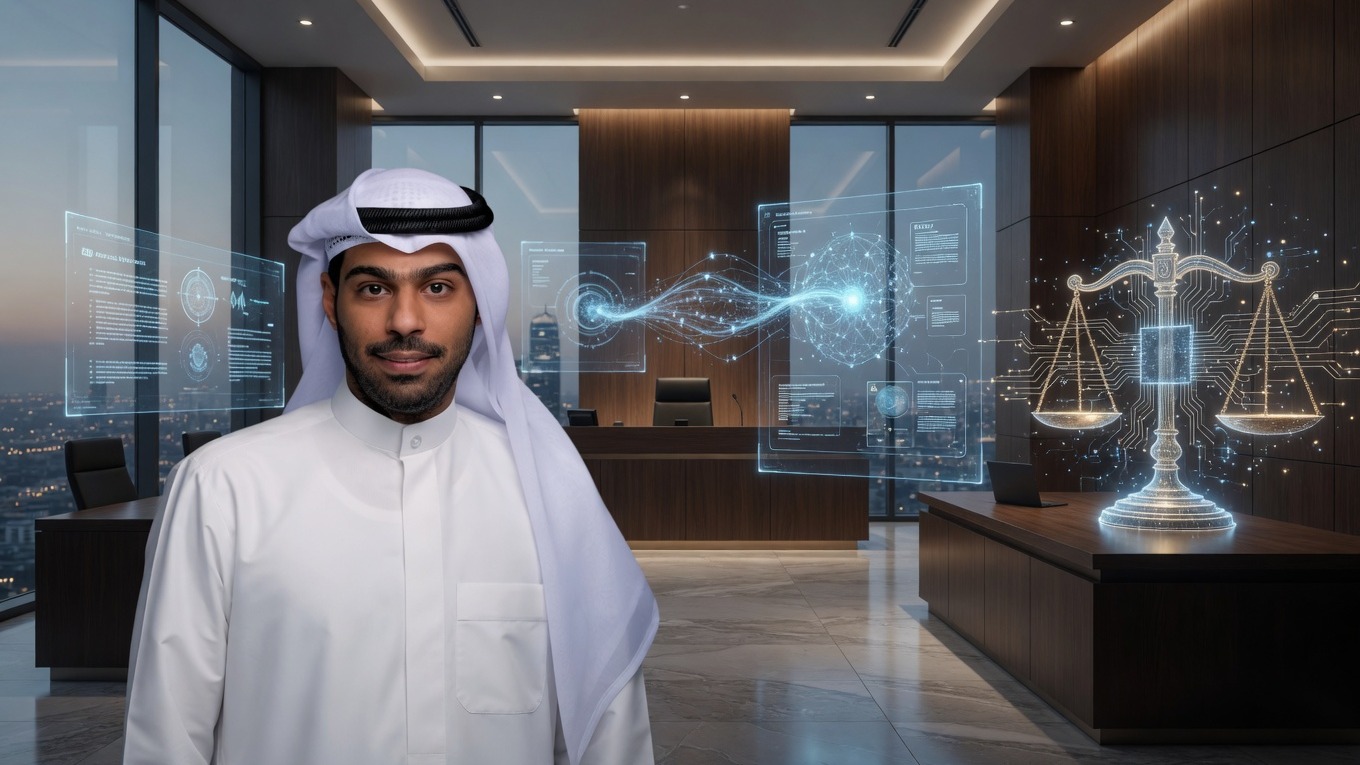
ABU DHABI — When Khaled Al Rasheed founded Oqood AI in 2024, the conventional wisdom in regional legaltech was that the GCC’s law firms would eventually adopt the same tools their counterparts in London and New York had been using for years. Eighteen months later, that assumption is being tested in real time.
Oqood AI, which closed a one-million-dollar seed round in October 2025 from a consortium of angel investors, has built its product on a contrarian premise: that Arabic-language legal AI is not a localisation problem to be solved later, but a core engineering challenge that determines whether a tool is usable in a GCC firm at all. The company’s platform offers bilingual contract drafting, document review, and access to regional laws and regulations — the latter being the piece global incumbents have struggled to match.
«This round reflects the growing investor interest in legal technology, a sector valued at more than thirty-one billion dollars in 2024 and projected to grow at an annual rate of 9.4 percent,» Khaled Al Rasheed said at the time of the raise. The company is now using the capital to expand commercial operations across the Gulf and to deepen its product around predictive analysis and workflow automation.
A market catching up, fast:
The timing is not accidental. Across the broader legal industry, adoption metrics have moved from gradual to vertical in a single calendar year.
The 2026 Wolters Kluwer Future Ready Lawyer Survey found that 92 percent of legal professionals now use at least one AI tool in their daily work, with 62 percent reporting weekly time savings of between six and twenty percent. A separate study released by FTI Consulting and Relativity in March 2026 reported that AI use among corporate general counsel had nearly doubled year-over-year, climbing from 44 percent in 2025 to 87 percent in 2026.
For GCC firms, those numbers describe a window that is closing. Regional law firms that had treated AI as a multi-year exploration are now finding their corporate clients — particularly in-house teams at banks, sovereign-linked entities, and family offices — arriving at meetings with their own AI workflows already operational. The pressure to match that cadence has become a commercial issue, not an aspirational one.
The bilingual problem:
The challenge for GCC firms adopting global tools has always been linguistic and jurisdictional rather than technical. A contract drafted in English under DIFC or ADGM law can be reviewed effectively by any frontier model. The same model, asked to interpret a notarised Arabic agreement governed by UAE federal civil code or Kuwaiti commercial law, has historically performed unevenly.
Oqood AI’s positioning — accessing laws, regulations, court rulings, and government documents from MENA jurisdictions in a single bilingual interface — is calibrated to that gap. The company has framed its product around the practical realities of GCC practice: matters that switch between Arabic and English mid-document, references to regional statutes that do not appear in Western training data, and counterparties who expect output in either language without quality loss.
Whether that approach scales depends on execution rather than thesis. Regional adoption of any legal tool tends to hinge on integration with existing firm software, willingness of senior partners to sign off on AI-assisted output, and the maturity of internal governance policies — an area where the GCC is still developing standards. A January 2026 analysis cited Clio data showing that 79 percent of legal professionals were using AI tools globally, while 44 percent of firms had yet to implement formal governance policies. The GCC figure is widely believed to be higher.
What comes next:
Oqood AI has indicated that it intends to use the next twelve to eighteen months to broaden its footprint beyond the UAE, with Saudi Arabia and Kuwait both flagged as priority markets. Strategic partnerships with regional legal associations and technology providers are also on the roadmap.
For the GCC’s legal sector, the more interesting question is structural. If a regional player can demonstrate that bilingual, jurisdiction-aware AI produces measurably better outcomes for Gulf firms than imported alternatives, the entire procurement conversation across the region shifts. Oqood AI is not the only company chasing that proof point — but it is, for now, among the most visible.
Добавить комментарий